The short answer
Why this topic matters
The central question in why this topic matters is not whether more data is available; it is whether the data changes a real decision. Understand how visitor identification relates to other intent-data categories. A useful implementation ties each signal to an explicit next step: research the account, check ownership, add context to an open opportunity, create a task, or place the visitor into a nurture path. When a team cannot name the decision that a signal improves, it is usually collecting information rather than building a revenue system.
Measurement needs to connect the signal to downstream behavior. A dashboard that only counts identified visitors can look impressive while saying little about business value. More useful measures include the share of signals that match the ICP, the share assigned to a real owner, median time to first meaningful action, meetings influenced, opportunities created or accelerated, and the number of alerts sales rejects as noise. Those measures reveal whether the system is improving prioritization or merely adding another inbox.
How the workflow works
For b2b intent data tools: first-party, third-party, and visitor signals, context matters more than a single event. A visit can be interesting without being purchase intent. Page type, recency, repeat activity, campaign source, company fit, known opportunity status, and the seniority or function of a resolved contact can all change interpretation. Mature teams therefore treat visitor intelligence as a layer of evidence. They avoid rules such as “every pricing-page visitor gets an email” and instead define thresholds that match their sales cycle and brand.
Governance belongs in the design rather than as a final checkbox. Review the vendor's current documentation, the tracking behavior, regional controls, cookie or consent requirements, privacy-policy language, data destinations, retention practices, and your own legal obligations. This publication is not a law firm and does not provide legal advice; organizations with material privacy exposure should involve qualified counsel and their security or data-governance stakeholders before deployment.
Signals worth paying attention to
The operating model should also make negative cases explicit. Some traffic belongs to customers, candidates, partners, vendors, competitors, employees, researchers, or people with no active buying project. Filters, exclusions, account ownership rules, and minimum-fit criteria reduce the chance that the sales team spends time on low-value alerts. This is one reason a smaller stream of high-context signals can outperform a much larger stream of unfiltered identities.
See RB2B on the merchant site
Visit RB2BWhat not to assume
Measurement needs to connect the signal to downstream behavior. A dashboard that only counts identified visitors can look impressive while saying little about business value. More useful measures include the share of signals that match the ICP, the share assigned to a real owner, median time to first meaningful action, meetings influenced, opportunities created or accelerated, and the number of alerts sales rejects as noise. Those measures reveal whether the system is improving prioritization or merely adding another inbox.
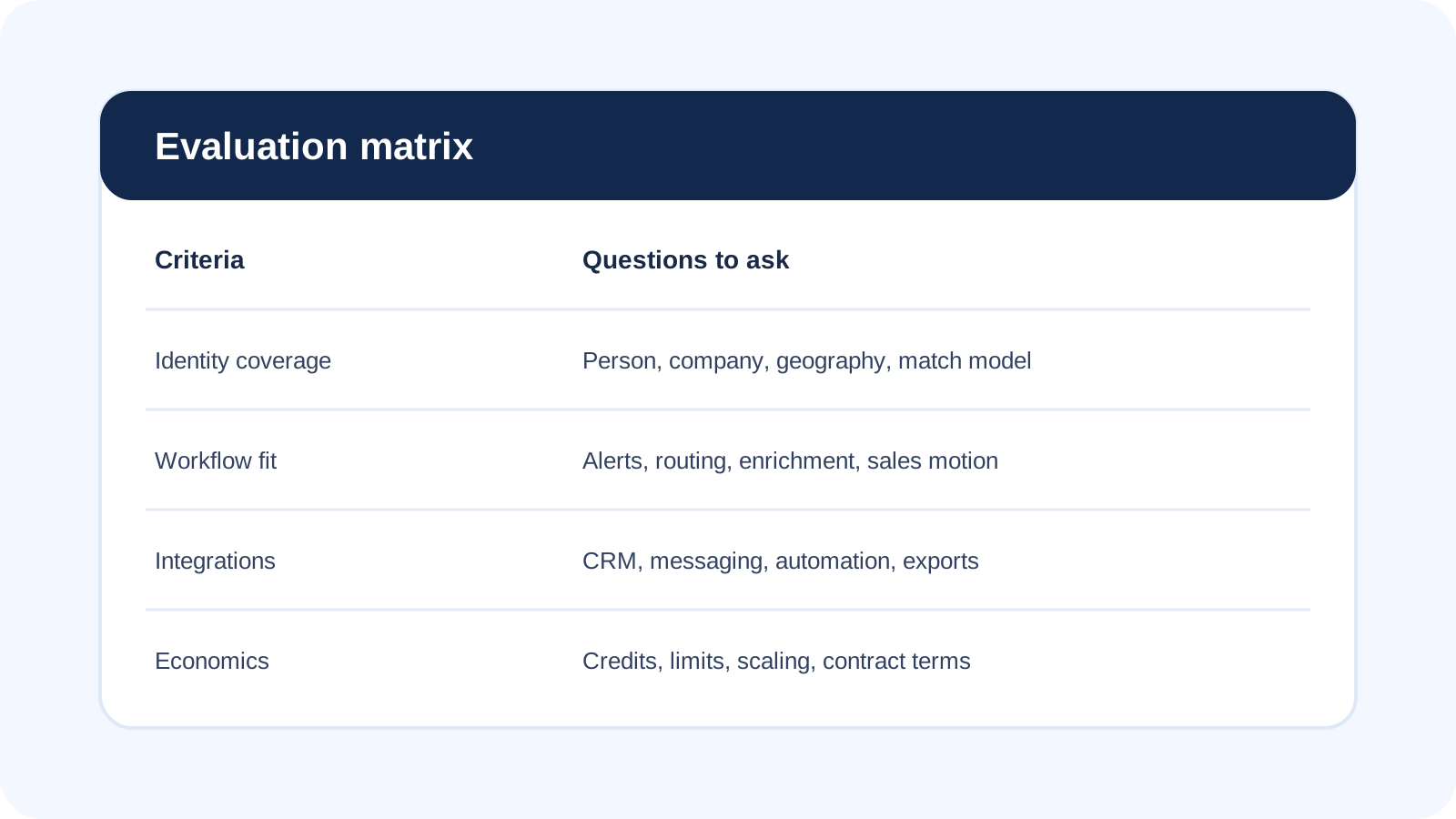
A strong evaluation process includes a controlled pilot. Choose a representative period, document baseline traffic, define target accounts or personas, decide who receives signals, and agree on what counts as a useful outcome. During the pilot, inspect both successes and false positives. The point is not to prove the tool works at any cost; it is to learn whether the combination of your traffic, the vendor's resolution, your sales motion, and your team's follow-through produces a repeatable advantage.
How to operationalize it
Governance belongs in the design rather than as a final checkbox. Review the vendor's current documentation, the tracking behavior, regional controls, cookie or consent requirements, privacy-policy language, data destinations, retention practices, and your own legal obligations. This publication is not a law firm and does not provide legal advice; organizations with material privacy exposure should involve qualified counsel and their security or data-governance stakeholders before deployment.
Internal adoption is often the hidden constraint. If alerts arrive in a channel nobody owns, if reps do not understand why a signal matters, or if the CRM cannot distinguish a new signal from an existing opportunity, the program will decay. Write a one-page operating policy that explains priority tiers, ownership, permitted outreach, do-not-contact rules, and escalation. That policy is more valuable than adding another integration before the team is ready.
Measurement framework
Finally, preserve a distinction between identification and qualification. Knowing that an organization or person visited a page does not establish budget, authority, need, or timing. It can, however, improve the order in which a team investigates accounts and the context it brings to an existing conversation. That more modest framing is usually both more accurate and more useful than treating every resolved visitor as a lead.
Privacy and governance
A strong evaluation process includes a controlled pilot. Choose a representative period, document baseline traffic, define target accounts or personas, decide who receives signals, and agree on what counts as a useful outcome. During the pilot, inspect both successes and false positives. The point is not to prove the tool works at any cost; it is to learn whether the combination of your traffic, the vendor's resolution, your sales motion, and your team's follow-through produces a repeatable advantage.
The central question in privacy and governance is not whether more data is available; it is whether the data changes a real decision. Understand how visitor identification relates to other intent-data categories. A useful implementation ties each signal to an explicit next step: research the account, check ownership, add context to an open opportunity, create a task, or place the visitor into a nurture path. When a team cannot name the decision that a signal improves, it is usually collecting information rather than building a revenue system.
See RB2B on the merchant site
Visit RB2BCommon failure modes
Internal adoption is often the hidden constraint. If alerts arrive in a channel nobody owns, if reps do not understand why a signal matters, or if the CRM cannot distinguish a new signal from an existing opportunity, the program will decay. Write a one-page operating policy that explains priority tiers, ownership, permitted outreach, do-not-contact rules, and escalation. That policy is more valuable than adding another integration before the team is ready.
For b2b intent data tools: first-party, third-party, and visitor signals, context matters more than a single event. A visit can be interesting without being purchase intent. Page type, recency, repeat activity, campaign source, company fit, known opportunity status, and the seniority or function of a resolved contact can all change interpretation. Mature teams therefore treat visitor intelligence as a layer of evidence. They avoid rules such as “every pricing-page visitor gets an email” and instead define thresholds that match their sales cycle and brand.
A practical implementation plan
Finally, preserve a distinction between identification and qualification. Knowing that an organization or person visited a page does not establish budget, authority, need, or timing. It can, however, improve the order in which a team investigates accounts and the context it brings to an existing conversation. That more modest framing is usually both more accurate and more useful than treating every resolved visitor as a lead.
The operating model should also make negative cases explicit. Some traffic belongs to customers, candidates, partners, vendors, competitors, employees, researchers, or people with no active buying project. Filters, exclusions, account ownership rules, and minimum-fit criteria reduce the chance that the sales team spends time on low-value alerts. This is one reason a smaller stream of high-context signals can outperform a much larger stream of unfiltered identities.
Decision checklist
| Area | Good practice | Warning sign |
|---|---|---|
| Signal quality | Combine fit, behavior, recency, and context. | Treat every identified visit as a qualified lead. |
| Routing | Assign a clear owner and next action. | Send all alerts to a noisy shared channel. |
| Outreach | Use the signal to prioritize relevant research. | Lead with language that feels invasive or overstates certainty. |
| Measurement | Track accepted signals and downstream revenue outcomes. | Report only raw visitor-identification volume. |
| Governance | Review consent, disclosure, regional rules, and legal obligations. | Deploy first and review privacy later. |
Turn the concept into an operating decision
The practical value comes from connecting the concept to a repeatable revenue workflow. For B2B Intent Data Tools: First-Party, Third-Party, and Visitor Signals, begin with the specific decision the signal is supposed to improve. Understand how visitor identification relates to other intent-data categories. The right threshold depends on how your team sells, how much qualified traffic reaches the site, and how quickly someone can act.
- Write down what the signal can tell you and, just as importantly, what it cannot prove.
- Combine identity with page context, recency, repetition, and account fit before assigning priority.
- Use a small number of meaningful thresholds rather than a complicated score nobody can explain.
- Create a clear next action for each priority level so information does not sit unused.
- Review outcomes and refine the rules based on qualified conversations, opportunities, and disqualified signals.
Before expanding the workflow around B2B Intent Data Tools: First-Party, Third-Party, and Visitor Signals, compare the signals that received action with the ones that were ignored or disqualified. Look for patterns in page path, recency, repeat activity, account fit, and the quality of the resulting conversation. A useful system should reduce uncertainty enough to improve prioritization without pretending that website behavior is the same as confirmed purchase intent. That review gives you a grounded reason to tighten a threshold, change a route, add context, or stop sending a class of alerts altogether.
The final decision should be easy to explain to someone outside the project: what changed, which signals proved useful, how much effort the process required, and what the team will do differently next. If those answers are unclear, collect more evidence before scaling.
Frequently asked questions
What is the main takeaway from B2B Intent Data Tools?
B2B Intent Data Tools is best understood as part of a broader signal-to-action system. The practical goal is to turn website behavior into useful context for prioritization while preserving uncertainty, respecting privacy requirements, and measuring whether the workflow creates better sales outcomes.
Does website visitor identification prove buying intent?
No. It can add context and improve prioritization, but a visit by itself does not prove budget, authority, need, or timing.
How should sales use visitor signals?
Use them to prioritize research, connect activity to known accounts, route high-fit signals, and write more relevant outreach without overstating what you know.
What should a team measure?
Track useful identification coverage, signal acceptance, routing speed, qualified meetings, opportunities influenced, and the amount of noise or false-positive work created.
Ready to evaluate RB2B on your own traffic?
Start with the current merchant offer and validate signal quality against your real website traffic and sales workflow.
Visit RB2B